
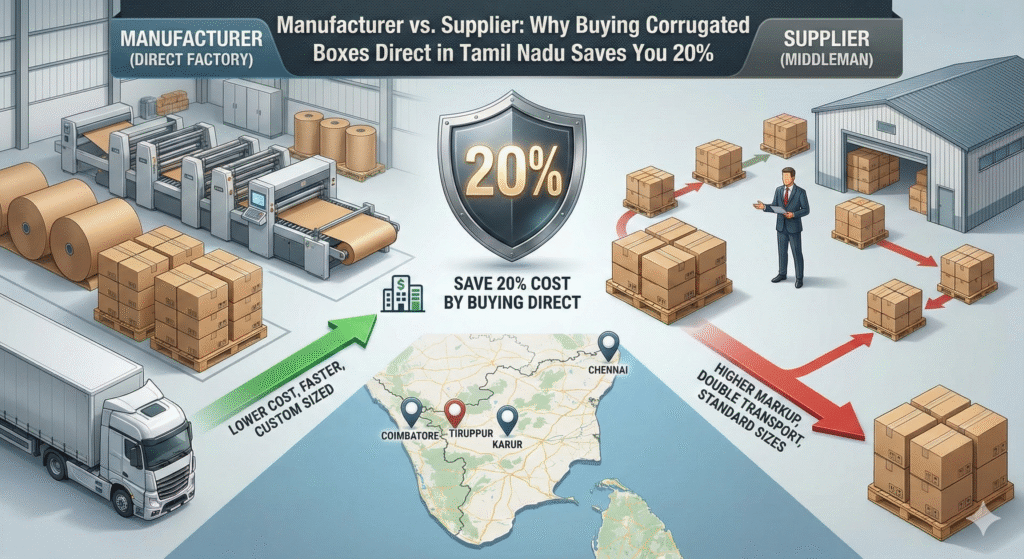
A manufacturer produces boxes directly from raw paper rolls using corrugation machinery, while a supplier is a middleman who buys finished boxes and resells them at a markup. Buying direct removes the middleman, saving you cost and allowing for custom sizing.
If you are a procurement manager in Chennai or a factory owner in Karur, you likely look at your packaging ledger every month and wonder why costs are inching up. The answer often isn’t the price of paper—it’s the price of the path that paper takes to get to you.
In the South Indian industrial ecosystem, the line between a “Corrugated Box Manufacturer” and a “Packaging Trader” is often blurred. Traders will often claim to be manufacturers, but they lack the machinery, the testing labs, and the raw material inventory to back that claim. Understanding this difference is not just about semantics; it is the single biggest lever you can pull to reduce your packaging budget by a flat 20% this fiscal year.
The “Middleman Math”: Where Does Your Money Go?
When you buy from a trader, you are not just paying for the box. You are paying for the box, the trader’s profit, the trader’s storage rental, and importantly, double transportation.
Let’s break down the math of a typical direct factory price corrugated box versus a trader-supplied box.
1. The Markup (10% – 15%)
A trader must make a profit to survive. If the manufacturing cost of a 5-Ply box is ₹45, a trader will typically add a margin of ₹5 to ₹7 per box. On a small order of 100 boxes, this is negligible. On a monthly recurring order of 5,000 boxes for an export shipment, you are effectively “donating” ₹25,000 to ₹35,000 purely for the privilege of having a middleman.
2. The Double Transportation Trap (5% – 8%)
Logistics in Tamil Nadu is efficient, but it isn’t free.
- Manufacturer Model: Factory → Your Warehouse. (One Trip).
- Supplier Model: Factory → Supplier Warehouse (Unload/Store/Reload) → Your Warehouse. (Two Trips).
Every time a corrugated box is loaded and unloaded, its structural integrity (Compression Strength) drops slightly due to handling. By buying from a supplier, you are paying for two transport legs and receiving a product that has been handled twice as much.
3. Inventory Holding Costs
Manufacturers typically operate on a “Just-in-Time” model for large clients. We convert reels to sheets and sheets to boxes based on your production schedule. Traders often sell from “dead stock”—standard sizes they bought in bulk months ago. Old stock absorbs moisture, especially in humid cities like Chennai, weakening the box before you even pack your product.
Customization: The Hidden Cost of “Standard Sizes”
One of the most common searches we see is for “3 ply 5 ply box price” lists. Traders love these lists because they sell “Standard Sizes” (e.g., 12x12x12).
But your product isn’t “standard.”
If you manufacture automotive components in Sriperumbudur, your part might be 11.5 inches long. If you buy a standard 12-inch box from a trader, you have 0.5 inches of empty space.
- The Risk: That 0.5-inch gap allows the product to shift during transit, leading to breakage.
- The Band-Aid: You end up spending more money on bubble wrap or fillers to fill the gap.
The Manufacturer Advantage: Exact Fit Engineering
As a corrugated box manufacturer in Tamil Nadu, we don’t push standard sizes. We adjust the machine settings to fit your product to the millimeter.
- Right GSM: We calculate the exact Grams per Square Meter needed for your stack height.
- Right Ply: We don’t upsell you to 7-ply if a high-BF 5-ply can do the job.
- Right Flute: We choose between B-flute (crush resistance) or C-flute (stacking strength) based on your needs.
This level of engineering saves you money by eliminating “Over-Spec” packaging (paying for strength you don’t need) and “Under-Spec” packaging (paying for damaged goods returns).
Local Context: Why Location Matters in Tamil Nadu
Tamil Nadu is a diverse industrial landscape, and your packaging partner needs to understand the local geography.
For Textile Exporters in Karur & Tiruppur
If you are shipping home textiles from Karur, you know that moisture is the enemy. A generic box from a general supplier might collapse when exposed to humidity in a shipping container. A local manufacturer understands the specific need for high-BF Kraft paper and moisture-resistant glues that ensure your bed linens arrive in Europe looking as crisp as they left the factory.
- Search focus: Packaging box manufacturers Karur
For Automobile OEMs in Chennai
The “Detroit of Asia” demands heavy-duty protection. Auto parts are heavy and dense. A trader might sell you a “strong box,” but a manufacturer will design a box with high Ring Crush Test (RCT) values specifically to handle the dead weight of metal components without buckling at the bottom of the pallet.
- Search focus: Wholesale carton boxes Chennai
Supply Chain Speed: Cutting the Chain Short
In 2026, speed is currency. Imagine you have a sudden surge in orders and need 2,000 boxes by Thursday.
- Scenario A (The Supplier): You call the supplier. He calls the factory. The factory checks paper stock. The factory tells the supplier “Maybe.” The supplier tells you “Yes” (hoping it works out). Thursday comes, and the boxes are delayed.
- Scenario B (The Manufacturer): You call us. We look at our floor stock of paper reels. We tell you “We can run this batch tomorrow morning.”
When you deal with the source, you get transparency. There is no “Telephone Game” where information gets distorted. If a machine breaks down, you know instantly. If raw material prices drop, you get the benefit instantly.
Trust & Quality: The Lab Report Difference
This is the ultimate litmus test to identify a real manufacturer.
Ask your current box vendor for a Bursting Strength (BS) Test Report for the last batch they delivered.
- A Trader will usually fumble, make excuses, or send you a generic spec sheet from Google.
- A Manufacturer will walk to their in-house Quality Control lab, pull the report from the batch testing machine, and email it to you.
At our facility, every batch undergoes:
- Burst Factor (BF) Test: How much pressure can the box take before rupturing?
- Cobb Test: How much water does the paper absorb?
- Compression Test: How much weight can the box hold when stacked?
If your supplier cannot prove these numbers, you are buying blind.
Key Takeaways
If you are serious about a financial reset for your procurement department in 2026, here is the summary of why you should switch to direct sourcing.
| Feature | Trader / Supplier | Manufacturer (Slvpacks) |
| Cost | Factory Price + 15-20% Markup | Factory Direct Price |
| Customization | Standard Sizes only | Any Size (L x W x H) |
| Lead Time | High (Dependencies involved) | Low (Direct Production) |
| Quality Check | Visual Check only | Lab Tested (BF/GSM Reports) |
| Accountability | Blames the factory for delays | Takes Full Ownership |
Conclusion: Stop Paying the Middleman Tax
In the competitive markets of Chennai, Karur, and Coimbatore, margins are thin. You negotiate hard on raw materials, you optimize your labor costs, and you streamline your logistics. Why, then, would you leave 20% on the table when buying your packaging?
It is time to audit your packaging supply chain. If you are paying for a middleman, you are paying for inefficiency.
Ready to secure your supply chain and cut costs? Contact [Your Company Name] today. As a leading Corrugated box manufacturer in Tamil Nadu, we invite you to visit our factory, see our corrugation lines in action, and get a quote that is free of hidden markups.
Get a quote Contact Us